Cloud computing has become the backbone of modern businesses. Whether you're developing applications, hosting websites, analyzing data, or implementing Artificial Intelligence (AI), cloud platforms provide scalable, secure, and cost-effective solutions.
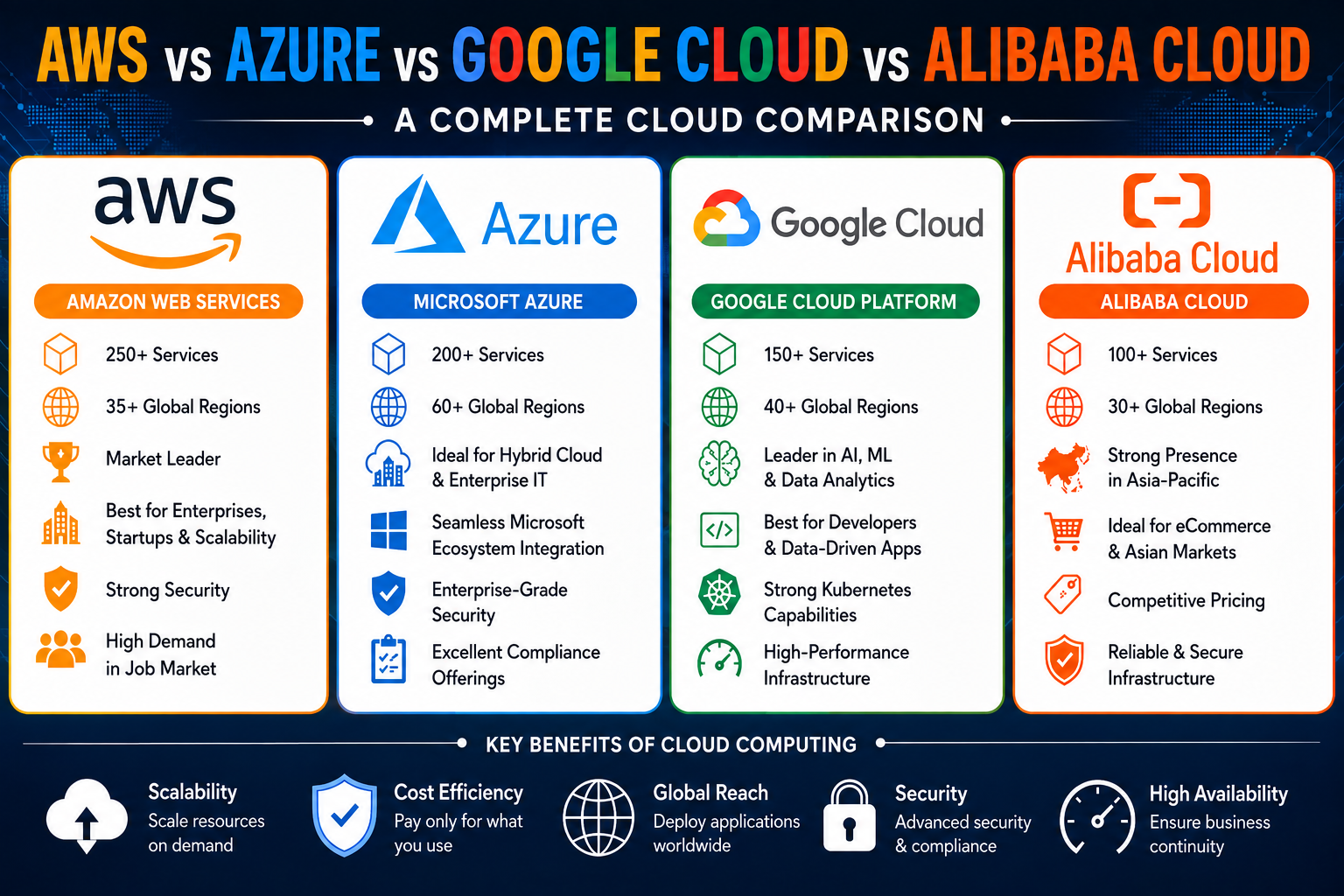
Among the leading cloud providers, Amazon Web Services (AWS), Microsoft Azure, Google Cloud Platform (GCP) , and Alibaba Cloud the market. But which one is the best for your career or business?
In this guide, we'll compare these cloud platforms based on their services, pricing, strengths, market share, certifications, and job opportunities.
Cloud computing is the delivery of computing services—including servers, storage, databases, networking, analytics, and AI—over the internet instead of maintaining physical infrastructure.
Benefits include:
| Feature | AWS | Microsoft Azure | Google Cloud | Alibaba Cloud |
|---|---|---|---|---|
| Launch Year | 2006 | 2010 | 2011 | 2009 |
| Market Position | #1 | #2 | #3 | #4 |
| Global Regions | 35+ | 60+ | 40+ | 30+ |
| Services Offered | 250+ | 200+ | 150+ | 100+ |
| Best For | Enterprises & Startups | Microsoft Ecosystem | AI & Data Analytics | Asian Markets |
| Learning Difficulty | Medium | Medium | Easy to Medium | Medium |
AWS is the world's largest cloud computing platform, trusted by millions of businesses, startups, and government organizations.
Key Services:
Amazon EC2, Amazon S3, Amazon RDS, AWS Lambda, Amazon VPC, Amazon ECS & EKS, CloudFront, IAM, CloudWatch etc.
Advantages
Limitations
Best For
Enterprise applications, Web hosting, DevOps, Machine Learning, IoT, Startups
Microsoft Azure is the preferred choice for organizations already using Microsoft technologies such as Windows Server, Active Directory, Office 365, and SQL Server.
Key Services:
Azure Virtual Machines, Azure App Service, Azure SQL Database, Azure Storage, Azure Functions, Azure Kubernetes Service (AKS), Azure DevOps, Azure Active Directory etc.
Advantages
Limitations
Best For
Enterprise IT, Hybrid cloud, Windows workloads, Corporate environments, Government organizations
Google Cloud Platform is recognized for its leadership in Artificial Intelligence, Machine Learning, Kubernetes, and Big Data analytics.
Key Services:
Compute Engine, Cloud Storage, BigQuery, Vertex AI, Google Kubernetes Engine (GKE), Cloud SQL, Cloud Functions, Cloud Run etc.
Advantages
Limitations
Best For
AI & Machine Learning, Data Analytics, Containerized applications, Startups, Research organizations
Alibaba Cloud is one of the fastest-growing cloud providers, particularly in China and the Asia-Pacific region. It offers cost-effective cloud solutions for businesses expanding into Asian markets.
Key Services:
Elastic Compute Service (ECS), Object Storage Service (OSS), ApsaraDB, Server Load Balancer, Container Service, Function Compute, CDN, Security Center etc.
Advantages
Limitations
Best For
Asian businesses, Cross-border eCommerce, Startups, SMEs, Businesses expanding into China
| AWS | Microsoft Azure | Google Cloud | Alibaba Cloud |
|---|---|---|---|
|
|
|
|
Learning cloud computing can open doors to high-demand roles, including:
| AWS | Microsoft Azure | Google Cloud | Alibaba Cloud |
|---|---|---|---|
|
|
|
|
Each cloud platform has its own strengths, and the best choice depends on your career goals:
For beginners, starting with AWS or Microsoft Azure provides a solid foundation. As your career progresses, learning multiple cloud platforms can significantly increase your versatility and job opportunities.
At IT Campus, we provide industry-focused, hands-on training to help you build cloud computing skills and earn globally recognized certifications.
Our Cloud Training Programs
Our expert instructors, practical labs, and real-world projects are designed to prepare you for today's cloud careers.
Ready to become a Cloud Professional? Contact IT Campus today and take the first step toward a rewarding career in cloud computing.
A modern IT training institute delivering industry-focused courses, practical projects, and expert mentorship to equip learners with real-world skills for successful IT careers.
A modern IT training institute delivering industry-focused courses, practical projects, and expert mentorship to equip learners with real-world skills for successful IT careers.